Israeli settlers in West Bank use cover of Iran war to attack and murder Palestinians
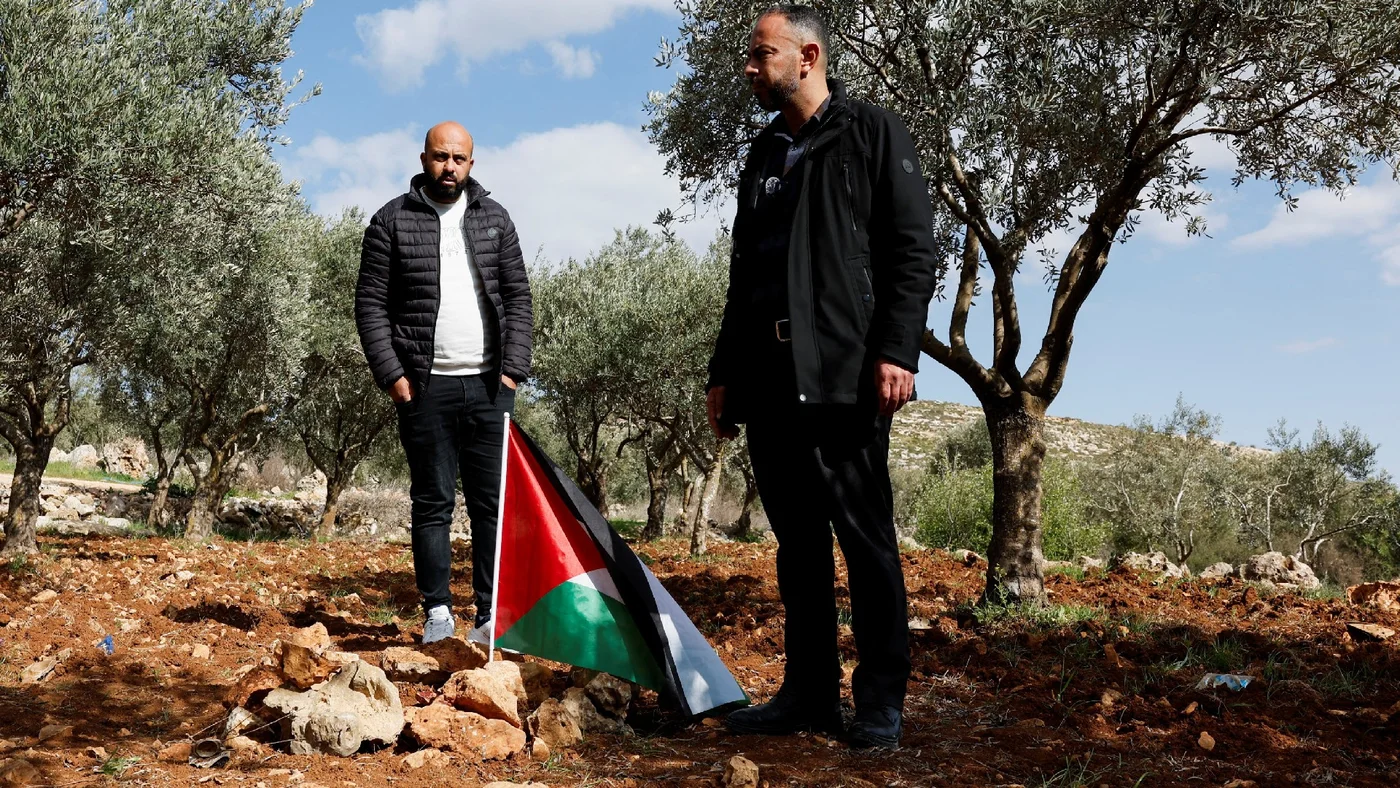
Early on Sunday morning, residents of Abu Falah, a small town near Ramallah in the occupied West Bank, spotted a group of around 100 Israeli settlers gathered on a hill near their homes.
The masked men then descended on the town, with the intention of razing Palestinian homes and evicting their residents.
The residents are used to continuous harassment by settlers from outposts dotting the surrounding hills, but say they have never experienced this scale of violence before.
They were panicked by the settlers, who were armed with M16 rifles, so they sent urgent messages via village WhatsApp groups. Other residents emerged from their homes to block the path of the attackers.
“When the settlers realised they couldn’t burn our homes, they opened fire on us,” Omar Hamayel, an eyewitness, told Middle East Eye.
Two of Hamayel's relatives were killed by the settlers: Fare Jawdat Abu Nurah, 57, and Faruq Hamayel, 30, were both shot in the head.
The attackers also left seven Palestinians injured.
“One man was shot in the thigh. While he was lying wounded on the ground, settlers attacked him with rocks, attempting to kill him with their fists and stones. Other Palestinians tried to pull him away and save him,” Hamayel said.
Teargas fired at medical centre
An hour and a half later, the Israeli military arrived. They fired teargas at residents gathered outside the medical centre, who had come to check on their relatives.
One of them, Muhammad Jawdat Abu Nurah, a 54-year-old father of four, who was asleep at the time of the attacks, emerged from his home only to suffer a cardiac arrest due to gas inhalation. He was rushed to hospital, where he was pronounced dead.
Following the attack, activists circulated footage on WhatsApp appearing to show a new settler outpost erected a few hundred metres away from the site of the killings.
The three killed in Abu Falah are among six Palestinians killed in settler attacks across the West Bank in the past week, as violence surges under cover of the US-Israel military assault on Iran.
The settler attacks were not concentrated in one area, but occurred in villages across the West Bank.
Days after the launch of the strikes on Iran, in the early hours of 2 March, settlers shot dead brothers Muhammad and Fahim Azem in the village of Qaryut, in the Nablus governorate.
A few days later, on the opposite end of the West Bank in Wadi a-Rahim, in the south Hebron hills, an armed settler killed 26-year-old Amir Muhammad Shanaran and severely injured his brother, Khaled.
Ameen Shoman, a member of the Fatah regional committee in Ramallah and Bireh, said that the surge in attacks has been accompanied by an acceleration of the establishment of illegal outposts, particularly in Areas B and C.
“Thousands of trees have been cut and hundreds of vehicles and tens of Palestinian homes have been burned,” Shoman told MEE.
“They are taking advantage of the conditions on the ground to impose a fait accompli policy through geographical and demographic changes in the Palestinian territories,” he said.
An ethnic cleansing 'opportunity'
An NGO worker based in the West Bank, who wished to remain anonymous for fear of reprisals, said the scale and severity of the violence is unprecedented.
‘I don't remember a week where six people would get killed by settlers, and in different areas all over the West Bank,” they told MEE.
“It's much more common now to hear that somebody has been killed by settlers or injured badly.
Since October 2023, over 1,000 Palestinians have been killed by settlers and Israeli soldiers across the occupied West Bank. One in five of them were children.
Yair Dvir, a spokesperson for B’Tselem, said the surge in killings is also due to the fact that settlers are increasingly deploying live ammunition, and targeting bigger villages in Area B, like Qaryut and Abu Falah.
Settler attacks previously targeted smaller rural communities in Area C – which constitutes roughly 60 percent of the West Bank and is under Israeli control – but are now spreading to larger towns in Area B, which is administered by the Palestinian Authority.
“We are seeing settlers talking about it openly, about the fact that they have the opportunity to increase the ethnic cleansing,” Dvir said.
According to B’Tselem, some 57 communities have been forcibly displaced since 7 October 2023, four of them in the past week alone.
Following Saturday’s attack on Abu Falah, the Israeli military issued a statement promising "zero tolerance for civilians taking the law into their own hands”.
Settlers have long conducted raids in collaboration with the military.
But now, the cooperation seems to be deepening, with settlers forming vigilante militias and being armed with military-grade weapons.
On Monday, Israeli National Security Minister Itamar Ben Gvir authorised some 300,000 residents of Jewish neighbourhoods in Jerusalem to carry firearms.
Jonathan Pollak, a member of Sumud, a network of Palestinian grassroots activists, reported that in the past week, settlers in civilian clothing had been seen manning checkpoints, along with Israeli soldiers.
He added that, also in the past week, armoured vehicles have been seen in villages.
“This is not something we’ve seen since the Second Intifada,” Pollak said. “And even then it was rare: heavy armoured vehicles were mostly used in cities and refugee camps, not in villages.
“The tactical reason for it is completely unclear, because they don’t do anything,” he said. “There seems to be no reason, other than to escalate.”
A lawless land
The Jordan Valley, which lies in Area C, offers a stark vision of where the rest of the West Bank is headed.
The fertile strip of land, which runs along the West Bank’s eastern flank, was once dotted with Palestinian herding communities. It is earmarked to form part of a future Palestinian state.
Now, it has largely been emptied of Palestinians by near daily settler attacks run from neighbouring illegal outposts.
Meanwhile, decades of Israeli policies have barred Palestinians from agricultural land by designating swathes of it “firing zones” and choking off water supplies.
“They can gain huge chunks of land by evicting small communities,” Amos Goldberg, a member of a network of Israeli activists, Jordan Valley Activists, told MEE.
“The daily harassment has become unbearable, it is completely lawless territory.”
The campaign was turbo-charged in the wake of 7 October 2023. Now, the takeover is almost complete.
In January, 12 families were forced to leave the last remaining Bedouin village in the southern Jordan Valley.
The weeks since the launch of the war on Iran have seen a slew of attacks on communities in the north, where only a handful remain.
On Tuesday night, activists reported that settlers stormed the last remaining homes in the community of Hammamat al-Maleh.
The hamlet has suffered eight attacks in the last two weeks alone.
Settlers reportedly assaulted 74-year-old Haj Abu al-Raed and two Israeli activists.
Activists reported that the assailants “broke the elder’s glasses and beat him until he bled”.
Days before, the commander of the Jordan Valley Brigade, Brigadier General Gilad Shriki, toured communities in the Northern Jordan Valley, including Hammamat al-Maleh, instructing them to leave.
Shriki warned them that his troops were constructing a barrier, which would seal the annexation of the area, severing it from the rest of the West Bank and barring farmers from reaching their land.
The separation barrier, which will run for 22km in the northern Jordan Valley, is the death knell for communities like Hammamat al-Maleh.
Shriki told the remaining communities they should leave now, to spare themselves the heartbreak of seeing their homes demolished.
"This is Area C," he said. "This land belongs to the Jews."